Research
When Are Tutors Free Worldwide? TutorTime Tutor Availability by UTC Hour, Day and Time Zone (2026)
Published 31 October 2026
Global tutor availability peaks at 12:00 UTC (39% free) and bottoms out at 22:00–01:00 UTC. 106 TutorTime tutors in 17 countries, plus after-school coverage in 9 cities.
All times in this report are in UTC (UTC+0) unless stated otherwise. Here's when 106 tutors in 17 countries say they can teach, which UTC hours have the most and fewest tutors, and how well after-school hours are covered from Los Angeles to Sydney.
TutorTime Research · Data snapshot: 12 October 2026 · Reference week: 12–18 October 2026 · Time zone: UTC
Price gets most of the attention when families look for a tutor, but the first question is often simpler: can this person teach when my child is free? TutorTime tutors can publish the weekly hours they're available on their profile, along with their time zone. This report takes those schedules for every public listing on tutortime.study on 12 October 2026, converts them all to one global clock (UTC), and shows when the world's tutors are free and which after-school windows around the world are easy or hard to cover with an online tutor.
Read this first: these are self-reported weekly schedules from TutorTime listings, not booked lessons or guaranteed openings. They describe TutorTime's tutors, not all tutors everywhere. See Methodology and limitations.
Key findings
- 55% of TutorTime tutors publish a weekly schedule (106 of 194 listings, 17 countries). The typical one offers about 32 hours a week across 5 days.
- Global tutor supply peaks at 12:00 UTC. On an average weekday, 39% of tutors with a schedule are free at 12:00 UTC, and the busiest band runs 08:00–15:00 UTC, when it's daytime from Lagos and London to Delhi and Manila.
- The thinnest hours are 22:00–01:00 UTC, when fewer than 10% of tutors are free (8% at 00:00 UTC). That's late afternoon and evening in the Americas.
- After-school coverage depends on where you live. Online tutors cover weekday 4–8pm (local) best in Dubai (64%, 12:00–16:00 UTC), Delhi (62%) and Taipei (58%), and worst across the Americas: São Paulo 30%, Los Angeles 30% and New York 26% (20:00–00:00 UTC).
- Monday is the busiest UTC day (86% of tutors have hours), Sunday the quietest (43%). Weekend supply is lower at every hour: at 12:00 UTC, 23% of tutors are free on an average weekend day, against 39% on a weekday.
- Regional example, Taiwan: 62% of online tutors can give a Taiwan student a full hour on weekday evenings (19:00–22:00 Taipei = 11:00–14:00 UTC), right on top of the global peak. Yet only 28% of Taiwan-based listings publish their hours, against 72% in the Philippines.
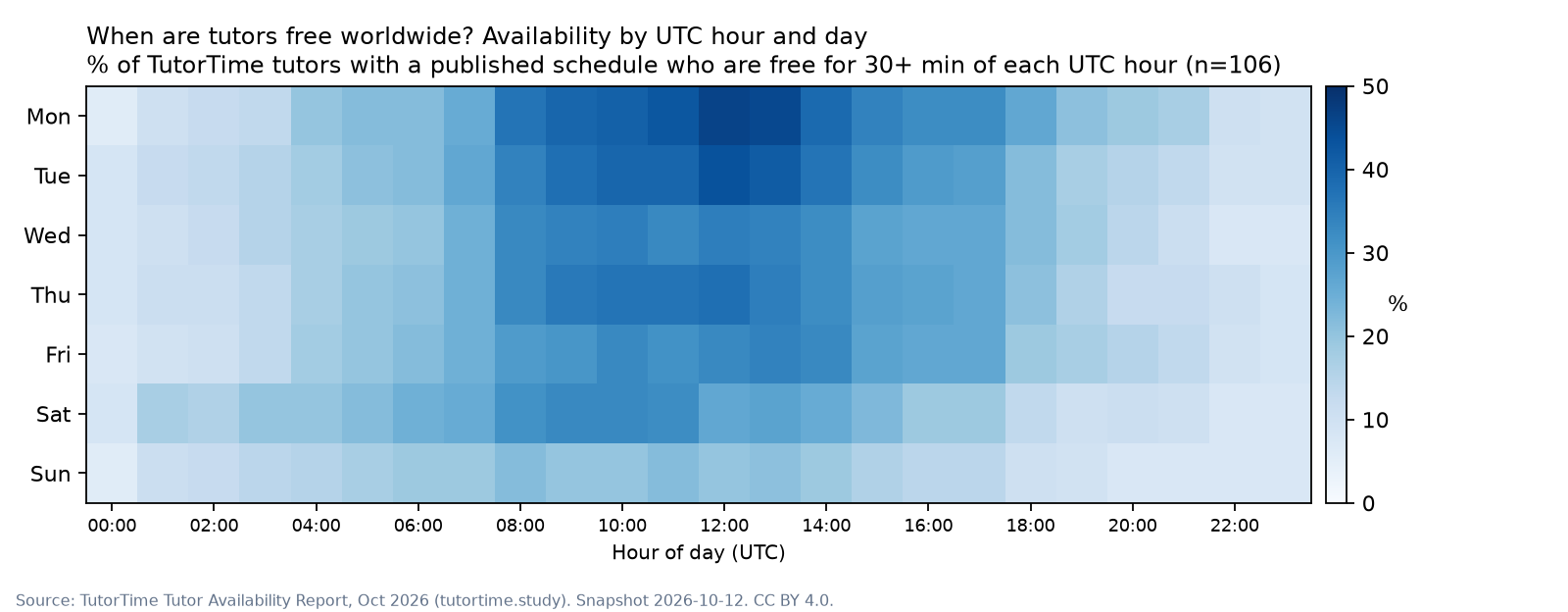
% of tutors free by UTC hour and day (every second hour shown; the full 168-hour grid is in the data download)
| UTC | Mon | Tue | Wed | Thu | Fri | Sat | Sun |
|---|---|---|---|---|---|---|---|
| 00:00 | 6% | 8% | 8% | 8% | 8% | 8% | 6% |
| 02:00 | 12% | 13% | 12% | 11% | 10% | 16% | 12% |
| 04:00 | 20% | 18% | 17% | 17% | 18% | 20% | 15% |
| 06:00 | 22% | 22% | 20% | 21% | 22% | 24% | 19% |
| 08:00 | 37% | 34% | 33% | 33% | 29% | 31% | 22% |
| 10:00 | 41% | 40% | 35% | 37% | 33% | 33% | 20% |
| 12:00 | 46% | 43% | 35% | 38% | 33% | 26% | 20% |
| 14:00 | 39% | 37% | 32% | 32% | 33% | 26% | 19% |
| 16:00 | 32% | 29% | 26% | 27% | 26% | 19% | 14% |
| 18:00 | 26% | 22% | 22% | 21% | 19% | 13% | 10% |
| 20:00 | 19% | 15% | 14% | 12% | 15% | 11% | 8% |
| 22:00 | 10% | 9% | 8% | 10% | 9% | 8% | 8% |
Global availability by UTC hour
On an average day, the share of tutors with a published schedule who are free for at least 30 minutes of each UTC hour:
| UTC hour | Weekday (Mon–Fri avg) | Weekend (Sat–Sun avg) |
|---|---|---|
| 00:00 | 8% | 7% |
| 02:00 | 12% | 14% |
| 04:00 | 18% | 18% |
| 06:00 | 21% | 22% |
| 08:00 | 33% | 26% |
| 10:00 | 37% | 26% |
| 12:00 | 39% | 23% |
| 14:00 | 35% | 22% |
| 16:00 | 28% | 17% |
| 18:00 | 22% | 12% |
| 20:00 | 15% | 9% |
| 22:00 | 9% | 8% |
Base: 106 TutorTime listings with a published weekly schedule, placed on the actual dates of the week of 12 October 2026. Full hourly table (every hour, every day, plus a breakdown by tutor region) in the data download.
The shape follows where tutors live. Supply builds from 08:00 UTC as tutors in Africa and Europe start their day, while South Asia and East and Southeast Asia are already working. It peaks at 10:00–13:00 UTC and fades through the evening, with US-based tutors carrying most of what's left after 18:00 UTC.
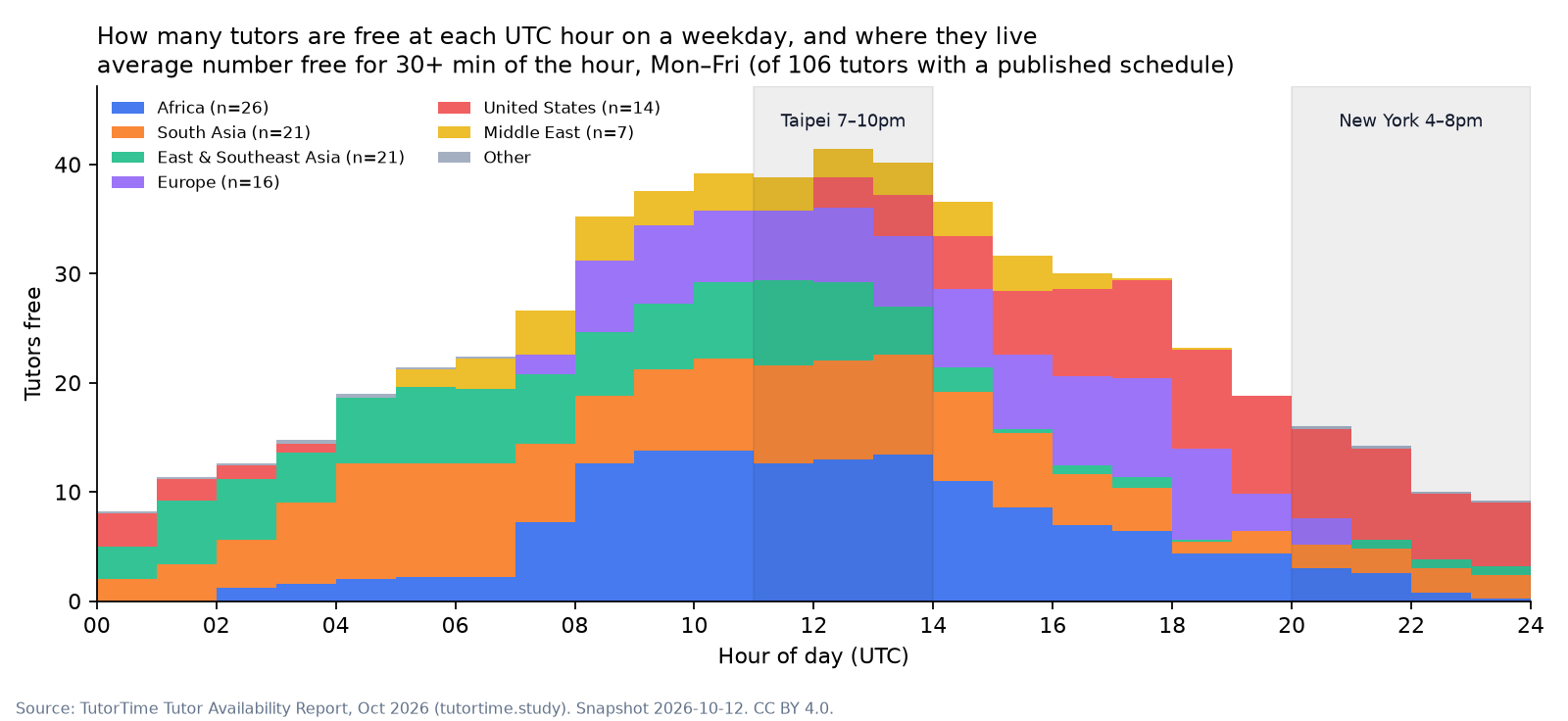
Average number of tutors free in each UTC hour, Mon–Fri, by where the tutor lives (every second hour shown)
| UTC | Africa (n=26) | South Asia (n=21) | East & Southeast Asia (n=21) | Europe (n=16) | United States (n=14) | Middle East (n=7) | Other |
|---|---|---|---|---|---|---|---|
| 00:00 | 0.0 | 2.0 | 3.0 | 0.0 | 3.0 | 0.0 | 0.2 |
| 02:00 | 1.2 | 4.4 | 5.6 | 0.0 | 1.2 | 0.0 | 0.2 |
| 04:00 | 2.0 | 10.6 | 6.0 | 0.0 | 0.0 | 0.0 | 0.4 |
| 06:00 | 2.2 | 10.4 | 6.8 | 0.0 | 0.0 | 2.8 | 0.2 |
| 08:00 | 12.6 | 6.2 | 5.8 | 6.6 | 0.0 | 4.0 | 0.0 |
| 10:00 | 13.8 | 8.4 | 7.0 | 6.6 | 0.0 | 3.4 | 0.0 |
| 12:00 | 13.0 | 9.0 | 7.2 | 6.8 | 2.8 | 2.6 | 0.0 |
| 14:00 | 11.0 | 8.2 | 2.2 | 7.2 | 4.8 | 3.2 | 0.0 |
| 16:00 | 7.0 | 4.6 | 0.8 | 8.2 | 8.0 | 1.4 | 0.0 |
| 18:00 | 4.4 | 1.0 | 0.2 | 8.4 | 9.0 | 0.2 | 0.0 |
| 20:00 | 3.0 | 2.2 | 0.0 | 2.4 | 8.2 | 0.0 | 0.2 |
| 22:00 | 0.8 | 2.2 | 0.8 | 0.0 | 6.0 | 0.0 | 0.2 |
In tutors' own local time the pattern is the familiar one: 45% are free at 11:00 local on a weekday, 26% at 20:00 and 16% at 21:00. School-age students are free in the late afternoon and evening, when local supply is already falling, so most families have to look across time zones.
The research on tutoring has something to say about timing. A meta-analysis of tutoring experiments by Nickow, Oreopoulos and Quan (NBER, 2020) found that tutoring raises learning by 0.37 standard deviations on average, and that programmes run during the school day tend to have larger effects than after-school ones. Most private tutoring can't happen during school, so the practical takeaway is to protect the quality of the time you do book: a slot when the student is alert, not squeezed in at the end of a long day. For teenagers, an online lesson that runs late because of a time difference also cuts into sleep; the US CDC recommends 8–10 hours a night for ages 13–17.
How well are after-school hours covered around the world?
We took the same window, Monday–Friday 16:00–20:00 local time, in nine major student cities, converted it to UTC for the week of 12 October 2026, and counted the online tutors (104 with a schedule) who have at least one continuous hour inside it on at least one day.
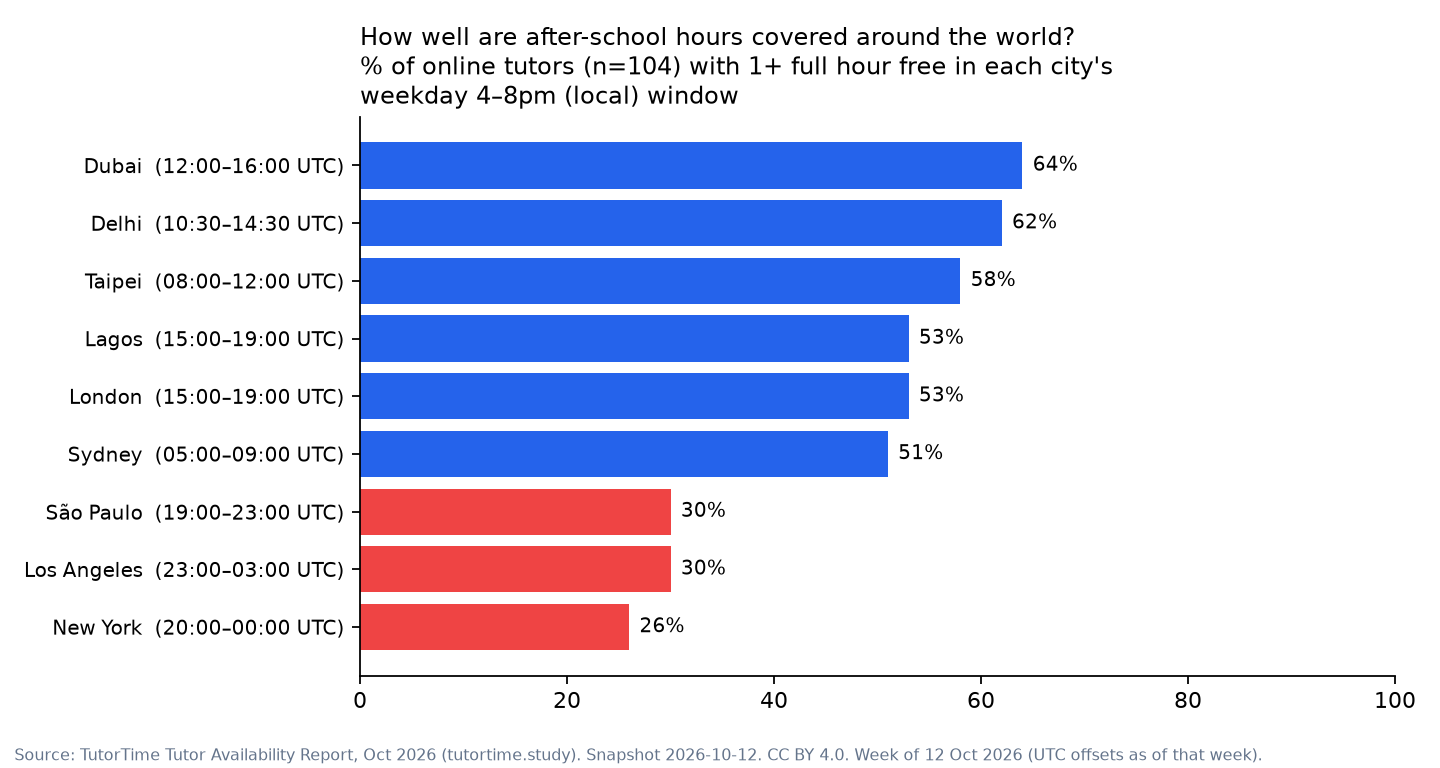
| City (UTC offset that week) | Weekday 16:00–20:00 local = UTC | Online tutors with a 1-hour slot |
|---|---|---|
| Dubai (UTC+4) | 12:00–16:00 | 64% |
| Delhi (UTC+5:30) | 10:30–14:30 | 62% |
| Taipei (UTC+8) | 08:00–12:00 | 58% |
| London (UTC+1) | 15:00–19:00 | 53% |
| Lagos (UTC+1) | 15:00–19:00 | 53% |
| Sydney (UTC+11) | 05:00–09:00 | 51% |
| São Paulo (UTC−3) | 19:00–23:00 | 30% |
| Los Angeles (UTC−7) | 23:00–03:00 | 30% |
| New York (UTC−4) | 20:00–00:00 | 26% |
Cities whose after-school window falls between roughly 08:00 and 19:00 UTC (Asia, the Middle East, Africa and Europe) have half or more of online tutors to choose from. Windows that fall in the 19:00–03:00 UTC trough, which covers the Americas, have under a third. That gap is the clearest opportunity in the data: online tutors outside the Americas who open late-evening slots in their own time zone could serve US and Latin American families after school.
Regional examples: Taiwan, the UK and the US East Coast
Four windows, each shown with its UTC equivalent for the week of 12 October 2026:
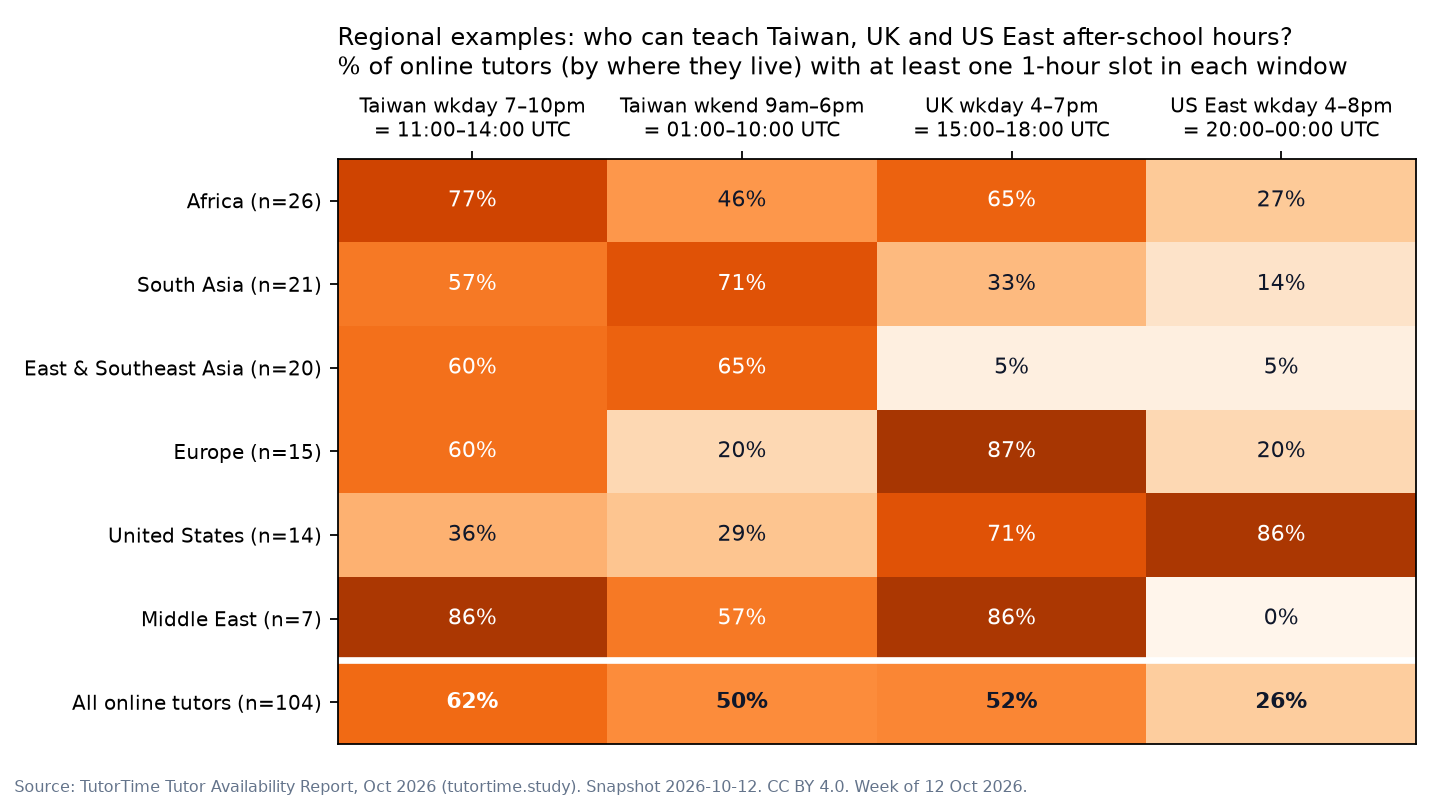
Share of online tutors with a 1-hour slot in each window, by where the tutor lives
| Tutors based in | Taiwan weekday 19:00–22:00 = 11:00–14:00 UTC | Taiwan weekend 09:00–18:00 = 01:00–10:00 UTC | UK weekday 16:00–19:00 = 15:00–18:00 UTC | US East weekday 16:00–20:00 = 20:00–00:00 UTC |
|---|---|---|---|---|
| Africa (n=26) | 77% | 46% | 65% | 27% |
| South Asia (n=21) | 57% | 71% | 33% | 14% |
| East & Southeast Asia (n=20) | 60% | 65% | 5% | 5% |
| Europe (n=15) | 60% | 20% | 87% | 20% |
| United States (n=14) | 36% | 29% | 71% | 86% |
| Middle East (n=7) | 86% | 57% | 86% | 0% |
| All online tutors (n=104) | 62% | 50% | 52% | 26% |
| Window (local time = UTC) | Online tutors with a 1-hour slot | Typical hours/week inside the window (among those tutors) |
|---|---|---|
| Taiwan, weekday 19:00–22:00 Taipei = 11:00–14:00 UTC | 62% (64 of 104) | 9.5 |
| Taiwan, weekend 09:00–18:00 Taipei = 01:00–10:00 UTC | 50% (52 of 104) | 6.5 |
| UK, weekday 16:00–19:00 London = 15:00–18:00 UTC | 52% (54 of 104) | 8 |
| US East, weekday 16:00–20:00 New York = 20:00–00:00 UTC | 26% (27 of 104) | 9 |
By where the tutor lives:
- Taiwan evenings (11:00–14:00 UTC) sit on the global peak, so they're covered from almost every direction: 77% of Africa-based tutors, 60% in East and Southeast Asia, 60% in Europe and 57% in South Asia. Only US-based tutors (36%) find it hard, because it's their night.
- Taiwan weekends (01:00–10:00 UTC) are best served from Asia: 71% of South Asia-based tutors and 65% in East and Southeast Asia, against 20% in Europe.
- UK after-school hours (15:00–18:00 UTC) are covered by Europe (87%), the Middle East (86%), the US (71%) and Africa (65%), but almost none of the tutors in East and Southeast Asia (5%), where it's already late at night.
- US East Coast after-school hours (20:00–00:00 UTC) are the hardest to fill. Outside the US itself (86%), coverage drops to 27% of Africa-based tutors and 14% in South Asia.
Clock changes: UTC never changes, but local clocks do. The UK and Europe move their clocks back on 25 October 2026 and the US on 1 November 2026; after that, London 16:00–19:00 becomes 16:00–19:00 UTC and New York 16:00–20:00 becomes 21:00–01:00 UTC. Sydney is already on daylight time (UTC+11). Taiwan, India, Nigeria and the UAE don't change. Always confirm the time zone with the tutor.
Country snapshot
Among listings with a published schedule (measured in each tutor's local time). Markets with at least 5 such listings:
| Tutor based in | Listings with a schedule | % of all listings in that country | Typical hours/week | Weekday evening (18–21 local, ≥1h) | Any weekend time | Browse |
|---|---|---|---|---|---|---|
| United Kingdom | 13 | 68% | 21 | 85% | 54% | Tutors in the UK |
| India | 11 | 48% | 54 | 73% | 91% | Tutors in India |
| Nigeria | 14 | 54% | 34 | 57% | 64% | Tutors in Nigeria |
| Taiwan | 7 | 28% | 30 | 57% | 57% | Tutors in Taiwan |
| Philippines | 13 | 72% | 26 | 54% | 77% | Tutors in the Philippines |
| United States | 14 | 61% | 42.5 | 50% | 71% | Tutors in the US |
| South Africa | 9 | 60% | 40 | 33% | 56% | Tutors in South Africa |
| Pakistan | 10 | 59% | 24 | 30% | 60% | Tutors in Pakistan |
Small samples (7 to 14 tutors per country), so treat country differences as indicative. UK tutors are the most evening-focused. Indian tutors offer the most hours and the most weekend time. Only 7 of 25 Taiwan-based tutors publish a schedule, so most Taiwan listings leave families to ask.
How to use this report
For parents and students
- Decide your window first. Write down the two or three weekly slots your child can actually do, then filter by tutors whose published hours fit.
- Convert your window to UTC and look across time zones. If your after-school window falls between 08:00 and 19:00 UTC (most of Asia, the Middle East, Africa and Europe), half or more of online tutors can cover it. In the Americas, look for tutors who state late-evening hours. Start with online tutors.
- Book a repeatable slot, not a one-off. The UK's Education Endowment Foundation finds one-to-one tuition adds about five months' progress on average, with short, regular sessions (about 30 minutes, three to five times a week, for up to ten weeks) appearing to work best. It also notes that digital tuition shows broadly similar effects. A tutor who can give you the same slot every week is worth more than one who's free once.
- Mind the clock. Confirm the tutor's time zone, check again after the October and November clock changes, and avoid lessons that run late into a teenager's sleep time.
For tutors
- Publish your hours. 45% of TutorTime listings don't show a schedule yet (72% in Taiwan, 52% in India). Families comparing tutors can only shortlist you for a slot if they can see it. List yourself free, or add weekly hours to your existing profile.
- The 19:00–03:00 UTC band is thin. Fewer than a third of online tutors can cover after-school hours in the Americas, and Sundays are quiet everywhere. If you can teach then, say so.
- Think in UTC, not just your own clock. If you teach online from Africa, South Asia or Europe, your late afternoon reaches East Asian evenings, and your late evening can reach families in the Americas after school.
- Listing on TutorTime is free and we take no commission, so the rate you set is the rate you keep.
Methodology and limitations
- Source. All public tutor listings shown on tutortime.study on 12 October 2026 (00:01 UTC): 194 listings, of which 106 published a weekly schedule. 104 of those 106 offer online lessons. No trimming or weighting.
- What we measure. Each tutor's self-reported weekly availability (day, start time, end time) and time zone, as shown on their profile. These are stated openings, not booked lessons or guaranteed free slots, and tutors may not keep them up to date.
- Time zone. All hours, heatmaps and windows are in UTC (UTC+0). Each tutor's weekly slots are placed on the actual dates of the reference week (Monday 12 – Sunday 18 October 2026) in the tutor's own time zone and converted to UTC, so daylight-saving time is handled for that week. Days in the UTC heatmap are UTC days.
- Hourly heatmap. A tutor counts as "free" in a UTC hour if their slots cover at least 30 minutes of it. One local-time comparison (45% at 11:00 local) uses the tutor's own clock and is labelled as such.
- Evening and weekend measures (country table). "Weekday evening" means at least one continuous hour between 18:00 and 21:00 local time, Monday to Friday. "Any weekend time" means any slot on Saturday or Sunday.
- After-school windows. For online tutors, each window (global: Mon–Fri 16:00–20:00 local in nine cities; regional: the four Taiwan, UK and US East windows) is converted to UTC for the reference week. A tutor counts if they have at least one continuous hour inside the window on at least one day. The windows are our own choices of typical after-school times, not official school hours, and the city list is illustrative, not a ranking of markets.
- Regions. Africa (Nigeria, South Africa, Kenya), South Asia (India, Pakistan), East and Southeast Asia (Taiwan, the Philippines, China), Europe (UK, Spain, the Netherlands, Poland), United States, and Middle East (UAE, Lebanon, Kuwait). These are the countries of online tutors with a published schedule in this snapshot. One online tutor elsewhere (Oceania) is included in overall figures but not shown separately.
- Privacy and statistics rules. Aggregates only. Every published figure rests on at least 5 listings. We never publish names, listing text or single-tutor details, so no individual tutor can be identified. Countries with fewer than 5 scheduled listings aren't reported separately but are included in overall figures. Medians are used for hours per week.
- A sample, not the whole market. TutorTime launched publicly in August 2026, so the sample is young and small. Tutors who publish schedules may differ from those who don't. Results describe TutorTime listings only.
- Reproducible. Every published aggregate is in the data download (CC BY 4.0), and the analysis can be rerun on live listings with the same method. We plan to refresh this report quarterly.
Cite this report
Source: TutorTime Tutor Availability Report, Oct 2026, tutortime.study/research/tutor-availability-2026
Journalists, bloggers and researchers are welcome to quote these figures with a link to this page. Please include the snapshot date (12 October 2026). The aggregate data and charts are published under CC BY 4.0: reuse them freely with credit and a link to TutorTime. Press questions: support@tutortime.study.
FAQ
What time of day are tutors most available worldwide? Around 12:00 UTC on weekdays, when 39% of TutorTime tutors with a published schedule are free. The busiest band is 08:00–15:00 UTC; the quietest is 22:00–01:00 UTC, when fewer than 10% are free (snapshot 12 Oct 2026).
Which after-school hours are hardest to cover? The Americas. Only 26% of online tutors can cover weekday 4–8pm in New York (20:00–00:00 UTC) and 30% in Los Angeles or São Paulo, compared with 64% in Dubai, 62% in Delhi and 58% in Taipei.
Can I find a tutor on Sundays? Yes, but fewer. 43% of tutors with a published schedule have hours on Sunday (UTC), compared with 58% on Saturday and 86% on Monday.
Can an online tutor in another country teach my child after school? Often, yes, depending on the time difference. For example, Taiwan weekday evenings (11:00–14:00 UTC) are covered by 77% of Africa-based online tutors on TutorTime, and UK after-school hours (15:00–18:00 UTC) by most tutors in Europe, the Middle East and Africa. US East Coast afternoons (20:00–00:00 UTC) are mostly covered by US-based tutors.
How often should my child have tutoring sessions? The Education Endowment Foundation's evidence review suggests short, regular sessions of about 30 minutes, three to five times a week, for up to ten weeks, work best for one-to-one tuition. That's why a tutor with a repeatable weekly slot matters.
Sources
- TutorTime public listings, tutortime.study, snapshot 12 October 2026 (aggregates in data-appendix.csv).
- Nickow, A., Oreopoulos, P. and Quan, V. (2020), "The Impressive Effects of Tutoring on PreK-12 Learning: A Systematic Review and Meta-Analysis of the Experimental Evidence", NBER Working Paper 27476: https://www.nber.org/papers/w27476
- Education Endowment Foundation, Teaching and Learning Toolkit, "One to one tuition": https://educationendowmentfoundation.org.uk/education-evidence/teaching-learning-toolkit/one-to-one-tuition (accessed 12 Oct 2026)
- US Centers for Disease Control and Prevention, "About Sleep" (recommended sleep by age): https://www.cdc.gov/sleep/about/index.html (accessed 12 Oct 2026)
- Related TutorTime research: What Tutors Charge in 2026 (link once published).