Research
Tutoring in Your Language: Which Languages Tutors Teach In Worldwide (TutorTime 2026)
Published 31 October 2026
41% of TutorTime tutors teach in 2+ languages and 46% in a language other than English. 212 tutors, 28 languages, 28 countries, plus the Spanish gap and UTC hours.
41% of TutorTime tutors teach in two or more languages, and nearly half can teach in a language other than English. Here's which languages families can find a tutor in, where multilingual tutors are based, which subjects can be taught in a home language, and when those tutors are free, in UTC.
TutorTime Research · Data snapshot: 19 October 2026 · 212 listings in 28 countries · Time zone: UTC
Around the world, a huge number of children are taught in a language they don't fully understand. UNESCO estimates that 40% of people globally lack access to education in a language they speak and understand fluently, rising to 90% in some low- and middle-income countries. The World Bank puts the figure at 37% of students in low- and middle-income countries, about 370 million children. And it isn't only a developing-world issue: 21.6% of pupils in England have a first language other than English, and 10.6% of US public school students (5.3 million) are English learners.
For those families, a tutor who can explain a tricky idea in the child's home language, or switch between two, can make the difference. TutorTime tutors list the languages they teach in on their profile. This report takes every public listing on tutortime.study on 19 October 2026 and shows what that supply looks like.
Read this first: languages are self-reported by tutors on their TutorTime listings and not tested by TutorTime. The figures describe TutorTime's tutors, not all tutors everywhere. See Methodology and limitations.
Key findings
- 41% of TutorTime tutors teach in two or more languages (86 of 212 listings), and 8% in three or more. Together they cover 28 languages.
- 46% can teach in a language other than English, while 93% teach in English. 54% teach in English only.
- After English, the most offered languages are Hindi (13% of tutors), Urdu (9%), Mandarin Chinese (9%), Arabic (5%), Spanish (4%), Filipino/Tagalog (4%) and French (3%).
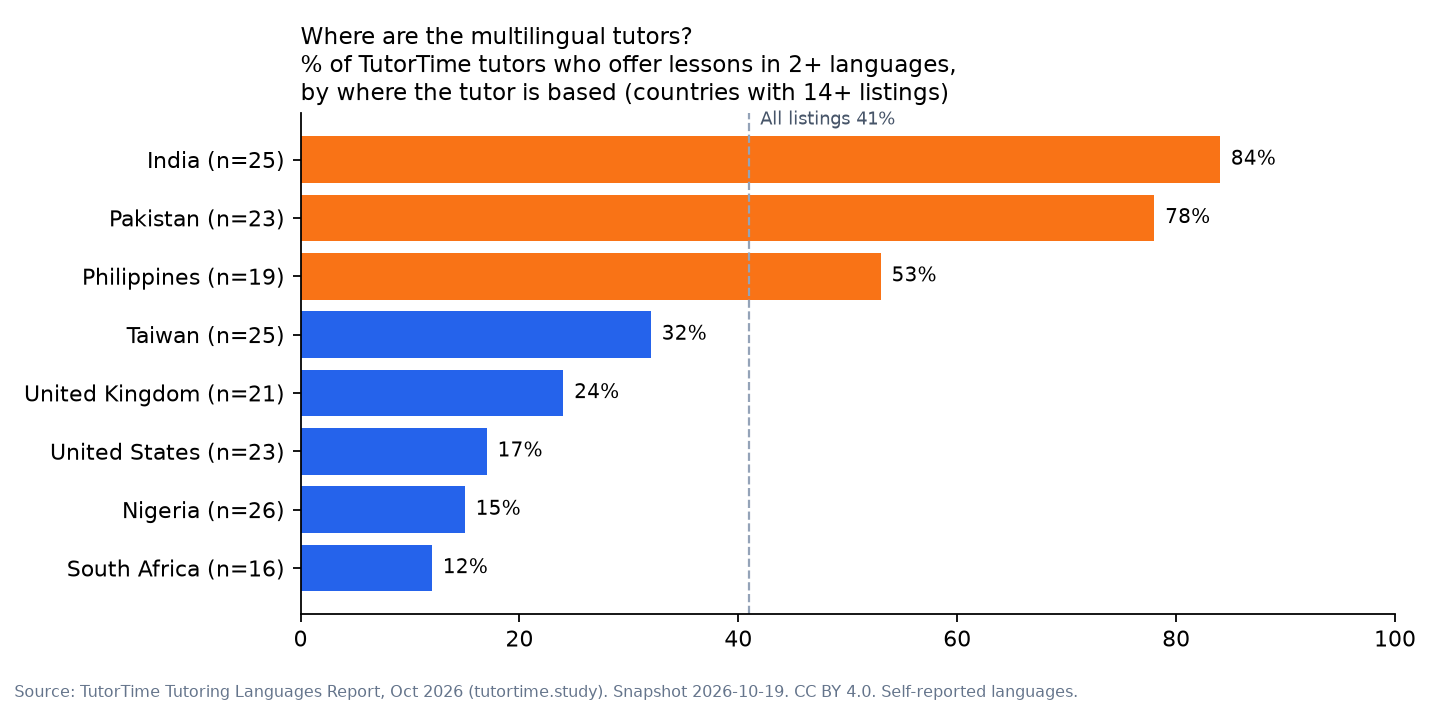
- Multilingual tutors are concentrated in South and Southeast Asia: 84% of tutors in India, 78% in Pakistan and 53% in the Philippines teach in 2+ languages, against 12–24% in South Africa, Nigeria, the US and the UK.
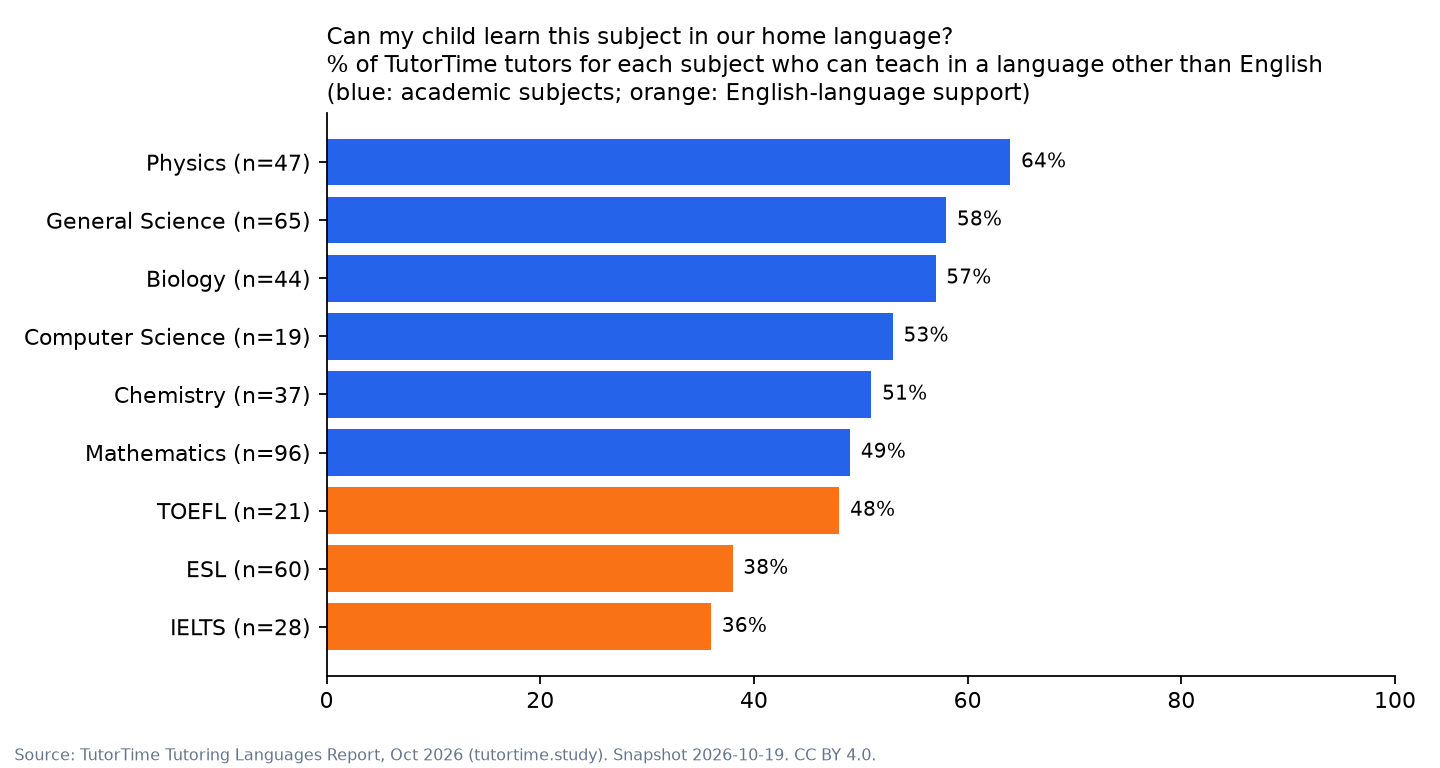
- Half of maths, science and computing tutors (50% of 124) can teach in a language other than English, rising to 64% for Physics. Hindi, Urdu, Mandarin, Arabic and Filipino are the most common.
- 38% of English-language tutors (ESL, IELTS, TOEFL) can also explain in another language, which helps beginners who need instructions in their first language.
- The biggest gap is Spanish. Spanish is the home language of 76.4% of US English learners (NCES, fall 2021), but only 4% of TutorTime tutors (9, based in 7 countries) teach in Spanish.
- Speaking more languages doesn't mean a higher price. Compared with tutors in the same country, tutors who teach in two languages price about the same (−3%).
- In UTC, language-matched tutors are freest at different times: Hindi-speaking tutors peak at 04:00–06:00 UTC (62% free on weekdays), Arabic-speaking tutors at 14:00–15:00 UTC (57%), and all tutors at 12:00 UTC (40%).
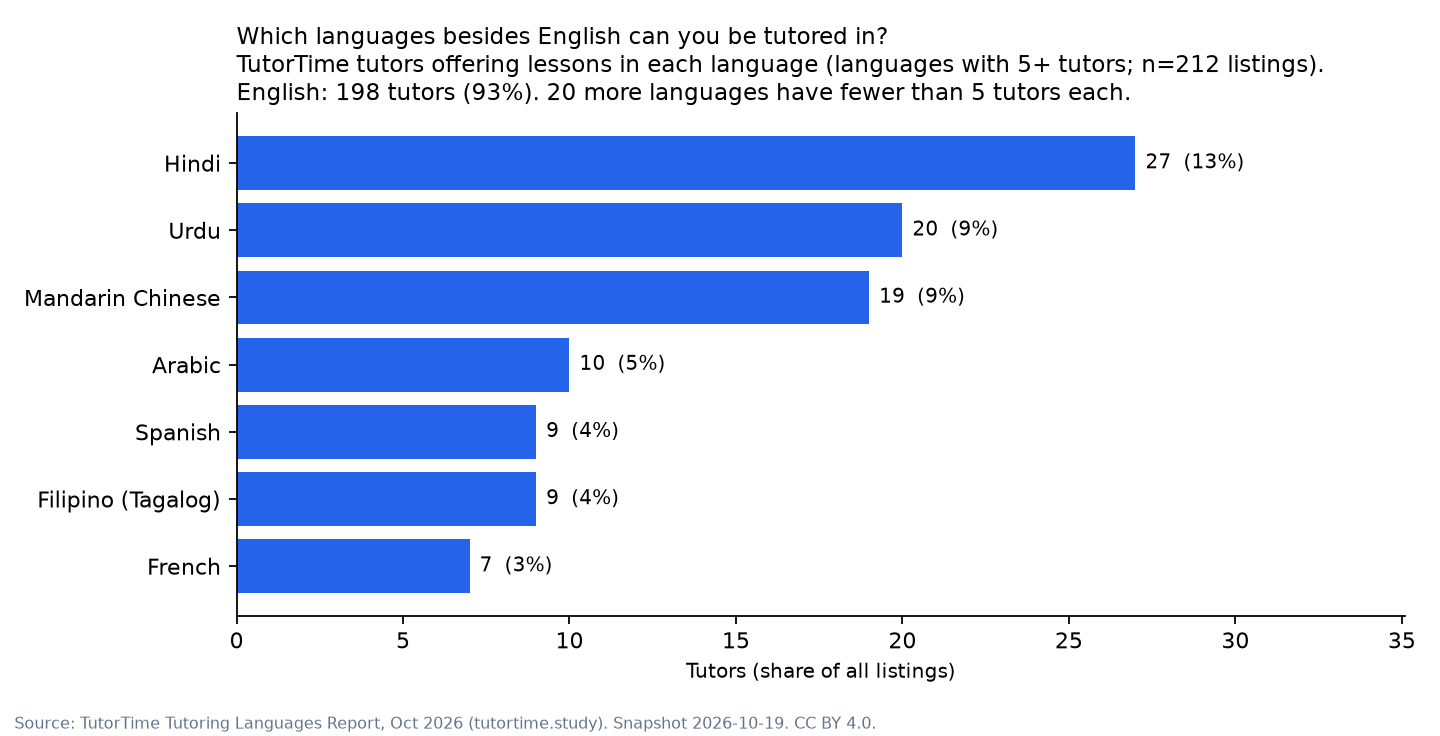
Which languages can you be tutored in?
Languages offered by at least 5 tutors (share of all 212 listings):
| Language | Tutors | % of all listings | Countries tutors are based in | Offer online lessons | Also teach in English | Browse |
|---|---|---|---|---|---|---|
| English | 198 | 93% | 27 | 97% | – | Online tutors |
| Hindi | 27 | 13% | 4 | 100% | 100% | Tutors in India |
| Urdu | 20 | 9% | 4 | 100% | 95% | Tutors in Pakistan |
| Mandarin Chinese | 19 | 9% | 4 | 84% | 53% | Mandarin tutors |
| Arabic | 10 | 5% | 5 | 100% | 80% | Online tutors |
| Spanish | 9 | 4% | 7 | 100% | 100% | Spanish tutors |
| Filipino (Tagalog) | 9 | 4% | 1 | 100% | 100% | Tutors in the Philippines |
| French | 7 | 3% | 5 | 100% | 71% | French tutors |
A further 20 languages are each offered by fewer than 5 tutors (27 listings in total). We don't name them, to protect individual tutors, but they include regional languages from West Africa, South Asia, the Philippines and Europe. Full figures are in the data download.
Two patterns stand out. First, almost every non-English language comes paired with English: all Hindi, Spanish and Filipino tutors also teach in English, as do 95% of Urdu tutors. That makes them genuinely bilingual options, able to teach in English and fall back on the home language when a concept doesn't land. Mandarin is the exception: only 53% of Mandarin-speaking tutors also list English, because most are Taiwan-based tutors teaching local students in Mandarin.
Second, some languages are home-grown and some travel. 85% of Urdu tutors are in Pakistan, 79% of Mandarin tutors in Taiwan and 70% of Hindi tutors in India. Spanish, Arabic and French tutors are spread across 5 to 7 countries each, and all of them teach online, so where a tutor lives matters less than when they're free.
Where are the multilingual tutors?
| Tutor based in | Listings | Teach in 2+ languages | Teach in a language other than English | Most common other language | Browse |
|---|---|---|---|---|---|
| India | 25 | 84% | 84% | Hindi (76%) | Tutors in India |
| Pakistan | 23 | 78% | 83% | Urdu (74%), Hindi (26%) | Tutors in Pakistan |
| Philippines | 19 | 53% | 53% | Filipino/Tagalog (47%) | Tutors in the Philippines |
| Taiwan | 25 | 32% | 64% | Mandarin Chinese (60%) | Tutors in Taiwan |
| United Kingdom | 21 | 24% | 24% | – | Tutors in the UK |
| United States | 23 | 17% | 22% | – | Tutors in the US |
| Nigeria | 26 | 15% | 19% | – | Tutors in Nigeria |
| South Africa | 16 | 12% | 12% | – | Tutors in South Africa |
Countries with at least 14 listings. "–" means no single other language reaches 5 tutors in that country.
In India, Pakistan and the Philippines, being taught in English alongside a national language is normal, and tutors list both. In Nigeria and South Africa, where many people also speak several languages, only 15% and 12% of tutors list more than one. That probably says more about how tutors fill in their profiles than about what they speak, and it means families looking for a Yoruba, Igbo, Hausa, Zulu or Afrikaans speaker should ask, not assume.
Regional example, Taiwan. Taiwan's Bilingual 2030 policy aims to strengthen English communication alongside Mandarin, especially for young people. On TutorTime, Taiwan-based tutors split three ways: 9 of 25 teach in English only, 8 in Mandarin only, and 7 list both Mandarin and English. For a Taiwan family that wants an English tutor who can explain grammar in Mandarin, the bilingual group is the one to look for.
Can my child learn a subject in our home language?
For many families, language support matters most in maths and science, where a child may understand the concept but get lost in the vocabulary. On TutorTime, half of maths, science and computing tutors (62 of 124) can teach in a language other than English.
| Subject | Tutors | Can teach in a language other than English | Browse |
|---|---|---|---|
| Physics | 47 | 64% | Physics tutors |
| General Science | 65 | 58% | Science tutors |
| Biology | 44 | 57% | Biology tutors |
| Computer Science | 19 | 53% | Computer Science tutors |
| Chemistry | 37 | 51% | Chemistry tutors |
| Mathematics | 96 | 49% | Maths tutors |
| TOEFL | 21 | 48% | – |
| ESL | 60 | 38% | ESL tutors |
| IELTS | 28 | 36% | IELTS tutors |
Among the maths, science and computing tutors, the most common other languages are Hindi (23 tutors), Urdu (15), Mandarin Chinese (9), Arabic (7) and Filipino (7).
English-language support. 72 tutors teach ESL, IELTS or TOEFL, from 19 countries. 38% of them can also teach in another language, most often Mandarin Chinese (7 tutors) or Filipino (7). For a beginner, a tutor who can give instructions in the student's first language can speed up the early lessons; for an advanced IELTS or TOEFL candidate, an English-only tutor may be the better fit.
UNESCO notes that children taught in the language they understand best read and comprehend better, which makes it easier to learn additional languages too. Private tutoring can't replace a school's language policy, but it can give a child extra time in a language they understand while they build up the school's language.
The Spanish gap
The clearest mismatch in the data is Spanish. In the US, Spanish is the home language of **76.4% of English learners** (4.0 million students, fall 2021), far ahead of Arabic (2.5%), English (2.2%, which NCES says may reflect multilingual households) and Chinese (1.8%). On TutorTime, only 9 tutors (4%) teach in Spanish, fewer than teach in Arabic (10) or Mandarin (19), and fewer than 5 of those publish a weekly schedule.
| Home language of US English learners (NCES, fall 2021) | Share of US English learners | TutorTime tutors who teach in it | Share of TutorTime listings |
|---|---|---|---|
| Spanish | 76.4% | 9 | 4% |
| Arabic | 2.5% | 10 | 5% |
| Chinese | 1.8% | 19 (Mandarin) | 9% |
| Urdu | 0.5% | 20 | 9% |
TutorTime's tutors aren't meant to mirror the US school population; most are based outside the US and teach students worldwide. But the gap is real, and it overlaps with the hardest time slot from our availability report: US after-school hours fall in the 19:00–03:00 UTC band, when few tutors are free. Spanish-speaking tutors who can teach in the US afternoon and evening are one of the most underserved groups on TutorTime. If that's you, list yourself free.
Do multilingual tutors charge more?
No. To compare fairly across countries, we divided each tutor's hourly price (in US$) by the median price in their own country, for the eight countries with at least 14 listings (177 priced listings).
| Languages taught | Priced listings | Price vs. own-country median |
|---|---|---|
| 1 language | 105 | +1% |
| 2 languages | 58 | −3% |
| 3 or more languages | 14 | −48% |
Tutors with two languages price about the same as single-language tutors in the same country. The small group listing three or more (most of them based in Pakistan or India) prices well below their national median, so treat that figure as indicative. Within countries the picture is mixed: in the UK, bilingual tutors' median is higher (US$50.6 vs US$41.1 an hour, 5 vs 16 listings), while in Taiwan, Pakistan and the Philippines it's lower. For families, the takeaway is simple: you usually don't have to pay extra for a tutor who speaks your language. See our tutor rates report for what drives price.
When are language-matched tutors free? (UTC)
Online tutoring lets a family pick a tutor who speaks their language from anywhere, as long as the hours line up. The chart shows, for each language with at least 5 tutors who publish a weekly schedule, the share free in each UTC hour on an average weekday (week of 19 October 2026).
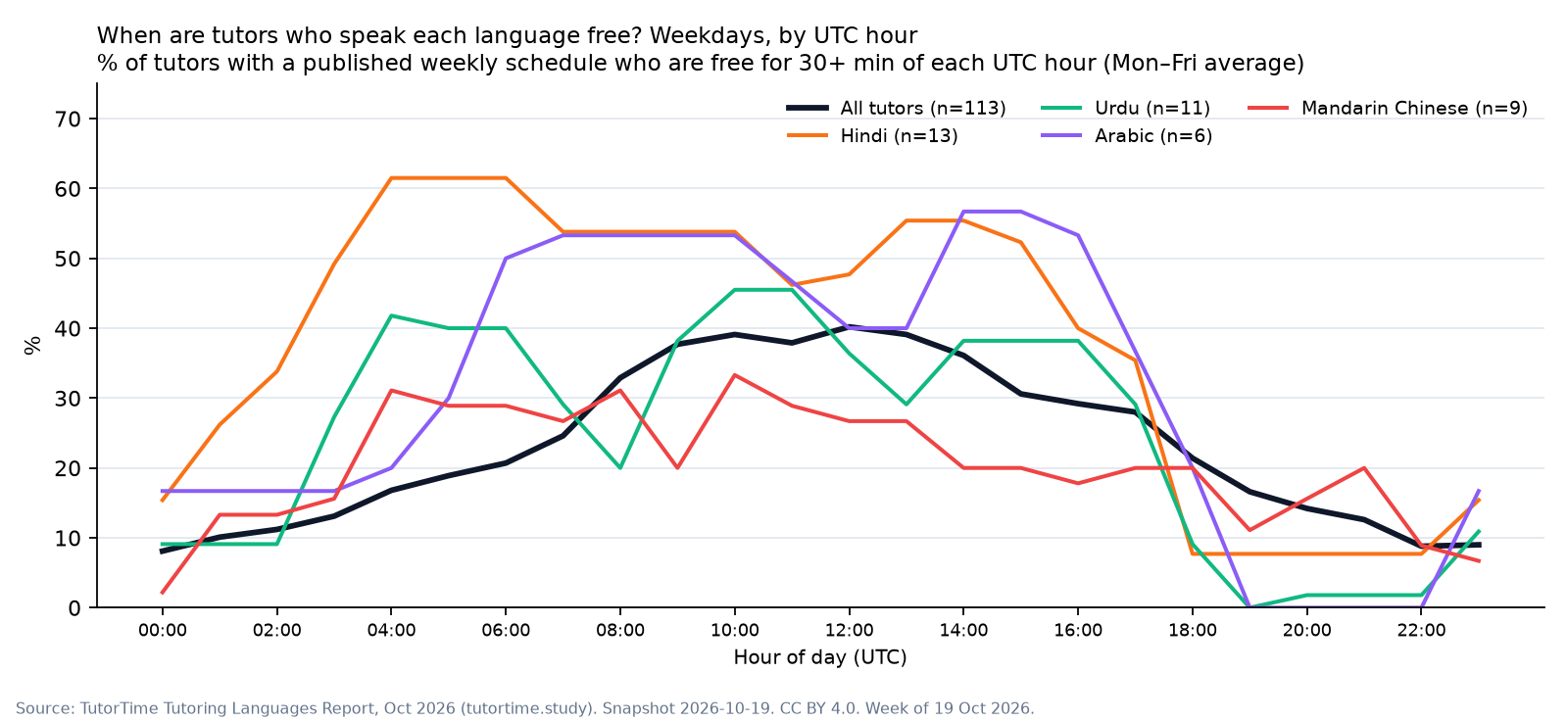
% of tutors free in each UTC hour, Mon–Fri average, by language taught (every second hour shown)
| UTC | All tutors (n=113) | Hindi (n=13) | Urdu (n=11) | Arabic (n=6) | French (n=6) | Mandarin Chinese (n=9) |
|---|---|---|---|---|---|---|
| 00:00 | 8% | 15% | 9% | 17% | 0% | 2% |
| 02:00 | 11% | 34% | 9% | 17% | 10% | 13% |
| 04:00 | 17% | 62% | 42% | 20% | 17% | 31% |
| 06:00 | 21% | 62% | 40% | 50% | 37% | 29% |
| 08:00 | 33% | 54% | 20% | 53% | 40% | 31% |
| 10:00 | 39% | 54% | 46% | 53% | 43% | 33% |
| 12:00 | 40% | 48% | 36% | 40% | 43% | 27% |
| 14:00 | 36% | 55% | 38% | 57% | 43% | 20% |
| 16:00 | 29% | 40% | 38% | 53% | 27% | 18% |
| 18:00 | 21% | 8% | 9% | 20% | 3% | 20% |
| 20:00 | 14% | 8% | 2% | 0% | 3% | 16% |
| 22:00 | 9% | 8% | 2% | 0% | 13% | 9% |
| Tutors who teach in | With a schedule | Weekday peak (UTC) | Free at peak |
|---|---|---|---|
| All languages | 113 | 12:00 | 40% |
| Hindi | 13 | 04:00–06:00 | 62% |
| Arabic | 6 | 14:00–15:00 | 57% |
| Urdu | 11 | 10:00–11:00 | 46% |
| French | 6 | 09:00–15:00 | 43% |
| Mandarin Chinese | 9 | 10:00 | 33% |
Hindi- and Urdu-speaking tutors are free from early in the UTC morning, which suits after-school hours in East Asia and Australia as well as South Asia itself. Arabic-speaking tutors peak in the UTC afternoon, which lines up with after-school hours in the Gulf and in Europe. Every language group thins out after 18:00 UTC, when it's afternoon in the Americas. Spanish isn't shown because fewer than 5 Spanish-speaking tutors publish a schedule.
How to use this report
For parents and students
- Decide which language matters for which subject. A child learning maths in their second language may do best with a tutor who can switch into the home language; an older student preparing for IELTS or TOEFL may want an English-only tutor.
- Look across borders for less common languages. Arabic, Spanish and French tutors on TutorTime are spread across 5 to 7 countries, and all teach online. Start with online tutors and check the languages on each profile.
- Ask, even if it isn't listed. Tutors in Nigeria, South Africa, the UK and the US list fewer languages than tutors elsewhere, but many speak more. A short message costs nothing.
- Check the hours in UTC. Convert your child's free time to UTC and compare it with the tutor's published hours. Our availability report shows which UTC hours are busiest.
For tutors
- List every language you can teach in. 54% of TutorTime tutors list English only. If you can explain a concept in Yoruba, Zulu, Hindi or Spanish, families searching for that will want to know. List yourself free, or update your profile.
- Spanish is under-supplied. Only 4% of tutors teach in Spanish, while Spanish is the home language of three in four US English learners. US afternoon and evening slots (roughly 20:00–03:00 UTC) are especially thin.
- Bilingual doesn't mean cheaper. Tutors with two languages price in line with their country's median. Set your rate on your experience and subject, not on how many languages you speak.
- Listing on TutorTime is free and we take no commission, so the rate you set is the rate you keep.
Methodology and limitations
- Source. All public tutor listings shown on tutortime.study on 19 October 2026 (00:00 UTC): 212 listings from 28 countries, each with at least one teaching language. No trimming or weighting.
- What we measure. The languages each tutor says they teach in ("instruction languages") on their profile. These are self-reported and not tested by TutorTime, and tutors may under-report languages they speak.
- Cleaning. Tutors can tick listed languages or type others. Typed entries were mapped to standard language names (for example "Filipino", "Tagalog" and "Filipino/Tagalog" all count as Filipino (Tagalog); entries listing two languages count for both). Two typed entries that weren't languages (a programming language and an art form) were dropped. "Mandarin Chinese" is the option tutors select; we don't distinguish Traditional or Simplified script.
- Multilingual. A tutor who lists two or more distinct languages. "Teach in a language other than English" means at least one listed language isn't English.
- Countries. Where the tutor says they're based. Countries with at least 14 listings are reported individually (the same threshold as our rates report); the rest are included in overall figures.
- Price comparison. Each tutor's US$ price (as shown on TutorTime) divided by the median US$ price in their own country, for the eight countries with 14+ listings. Each group's figure is the geometric mean of those ratios, shown as a percentage above or below 1. Within-country medians are shown only where both groups have at least 5 priced listings.
- Availability. For tutors who publish a weekly schedule (113 listings), slots are placed on the actual dates of the week of 19–25 October 2026 in the tutor's own time zone and converted to UTC. A tutor counts as free in a UTC hour if their slots cover at least 30 minutes of it; figures are Monday–Friday averages.
- Outside data. US figures are from NCES (fall 2021, the latest year published in the Condition of Education indicator); England figures are from the Department for Education's 2025/26 school census. They give context on demand and aren't directly comparable with TutorTime listings.
- Privacy and statistics rules. Aggregates only. Every published figure rests on at least 5 listings. Languages offered by fewer than 5 tutors are counted but not named. We never publish names, listing text or single-tutor details, so no individual tutor can be identified.
- A sample, not the whole market. TutorTime launched publicly in August 2026, so the sample is young and small, and it reflects the countries where TutorTime has recruited tutors so far. Results describe TutorTime listings only.
- Reproducible. Every published aggregate is in the data download (CC BY 4.0), and the analysis can be rerun on live listings with the same method. We plan to refresh this report twice a year.
Cite this report
Source: TutorTime Tutoring Languages Report, Oct 2026, tutortime.study/research/tutoring-languages-2026
Journalists, bloggers, teachers and researchers are welcome to quote these figures with a link to this page. Please include the snapshot date (19 October 2026). The aggregate data and charts are published under CC BY 4.0: reuse them freely with credit and a link to TutorTime. Press questions: support@tutortime.study.
FAQ
Can I find a tutor who teaches in my child's home language? Often, yes. 46% of TutorTime tutors can teach in a language other than English, covering 28 languages in total. The most common after English are Hindi, Urdu, Mandarin Chinese, Arabic, Spanish, Filipino (Tagalog) and French (snapshot 19 Oct 2026).
How many tutors are bilingual? 41% of TutorTime tutors teach in two or more languages and 8% in three or more. The share is highest among tutors based in India (84%), Pakistan (78%) and the Philippines (53%).
Do bilingual tutors cost more? Not on TutorTime. Compared with other tutors in the same country, tutors who teach in two languages price about the same (−3%).
Can my child learn maths or science in a language other than English? Yes. Half of TutorTime's maths, science and computing tutors (50% of 124) can teach in another language, most often Hindi, Urdu, Mandarin Chinese, Arabic or Filipino. For Physics the share is 64%.
Should an English tutor speak my child's first language? It helps beginners most. 38% of TutorTime's ESL, IELTS and TOEFL tutors can also explain in another language. Advanced students preparing for an exam may prefer an English-only tutor for full immersion.
Why are Spanish-speaking tutors hard to find? Only 4% of TutorTime tutors teach in Spanish, even though Spanish is the home language of 76.4% of US English learners (NCES, fall 2021). TutorTime is actively looking for more Spanish-speaking tutors, especially for US afternoon and evening hours.
Sources
- TutorTime public listings, tutortime.study, snapshot 19 October 2026 (aggregates in data-appendix.csv).
- UNESCO (2025), "New UNESCO report calls for multilingual education to unlock learning and inclusion" (on Languages matter: Global guidance on multilingual education): https://www.unesco.org/en/articles/new-unesco-report-calls-multilingual-education-unlock-learning-and-inclusion (accessed 19 Oct 2026)
- UNESCO, "Multilingual education: what you need to know": https://www.unesco.org/en/languages-education/need-know (accessed 19 Oct 2026)
- World Bank (2021), Loud and Clear: Effective Language of Instruction Policies for Learning: https://www.worldbank.org/en/topic/education/publication/loud-and-clear-effective-language-of-instruction-policies-for-learning
- National Center for Education Statistics, Condition of Education, "English Learners in Public Schools" (last updated May 2024, data for fall 2021): https://nces.ed.gov/programs/coe/indicator/cgf/english-learners-inpublic-schools
- UK Department for Education, "Schools, pupils and their characteristics", academic year 2025/26 (published 4 June 2026): https://explore-education-statistics.service.gov.uk/find-statistics/school-pupils-and-their-characteristics/2025-26
- National Development Council (Taiwan), "Bilingual 2030": https://www.ndc.gov.tw/en/Content_List.aspx?n=BF21AB4041BB5255
- Related TutorTime research: What Tutors Charge in 2026 and When Are Tutors Free Worldwide? (links once published).