Research
Tutoring Without Borders: How Online Tutors Teach Students in Other Countries (TutorTime 2026)
Published 9 November 2026
98% of TutorTime tutors teach online, and 2 in 3 tutors who price in pounds live outside the UK. Who teaches across borders, what they charge and when.
98% of TutorTime's tutors teach online, and many of them set their prices for students in another country. Two in three tutors who price their lessons in British pounds live outside the UK. We looked at 250 tutors in 35 countries to see who teaches across borders, what they teach, what they charge, and whether their hours fit students abroad.
TutorTime Research · Data snapshot: 9 November 2026, 00:01 UTC · Next update: May 2027
Education is now something a country can export down a video call. Digitally delivered services, the category that includes remote education, reached US$4.78 trillion of world exports in 2024, or 14.8% of all exports of goods and services (WTO, 2025). Demand for private tutoring is high in the places these tutors serve: 29% of secondary pupils in England and Wales have had a private tutor, rising to 45% in London (Sutton Trust, 2026).
Distance doesn't have to cost results either. In a randomised trial in Italy, three hours a week of one-to-one online tutoring raised maths scores by 0.22 standard deviations in 2020 and 0.20 in 2022 (Carlana & La Ferrara, *American Economic Review*). That is in the same range as tutoring in general, which raised learning by 0.37 standard deviations on average across 96 randomised studies (Nickow, Oreopoulos & Quan, NBER 2020).
So who is on the other end of the call? This report uses every public tutor listing on TutorTime, a free listing board where tutors set their own rate, choose their own price currency and keep all of their fee.
> Read this first: these figures describe tutors listed on TutorTime, not all tutors in the world or in any country. We can't see where students live, so we use the currency a tutor prices in as a signal of the market they aim at (for example, a tutor in Nigeria who prices in pounds is most likely aiming at UK families). Prices are advertised asking rates, not what families paid. See [Methodology and limitations](#methodology-and-limitations).
Key findings
- Online is the default: 98% of TutorTime tutors teach online and 72% teach only online. 28% also offer in-person lessons, and just 2% (6 tutors) teach in person only.
- Where a tutor lives decides whether they meet students in person. 94% of tutors in Nigeria teach online only, compared with 50% in the United States and 13% in Taiwan.
- Two in three tutors who price in pounds live outside the UK. Of 72 tutors who charge in £, 68% (49) are based abroad, more than twice as many as the 23 based in the UK. Nigeria (18%), India (15%) and Pakistan (10%) lead, and the rest come from 15 other countries.
- Pricing for UK families pays. In Nigeria, India and Pakistan, tutors who price in pounds ask a median 52% to 95% more than tutors in the same country who price in US dollars, or +65% taken together.
- UK-facing tutors abroad teach UK exams and have more experience. 45% of £-priced tutors outside the UK teach IGCSE or A Levels (34% of $-priced tutors outside the US), 31% teach IB (18%), and their median experience is 8 years (6).
- Their hours follow the UK school day. 54% of £-priced tutors abroad who publish a schedule are free for at least an hour on weekday afternoons from 16:00 to 19:00 UTC (UK after school), compared with 31% of other tutors outside the US.
- US evenings are the hardest slot to fill from abroad. Only 19% of tutors outside the US who publish a schedule are free during US East Coast after-school hours (21:00–01:00 UTC), against 86% of US-based tutors.
- The pattern is stable. The share of £-priced tutors living outside the UK was 67% on 8 October, 69% on 26 October and 68% on 9 November 2026.
Online is the default almost everywhere
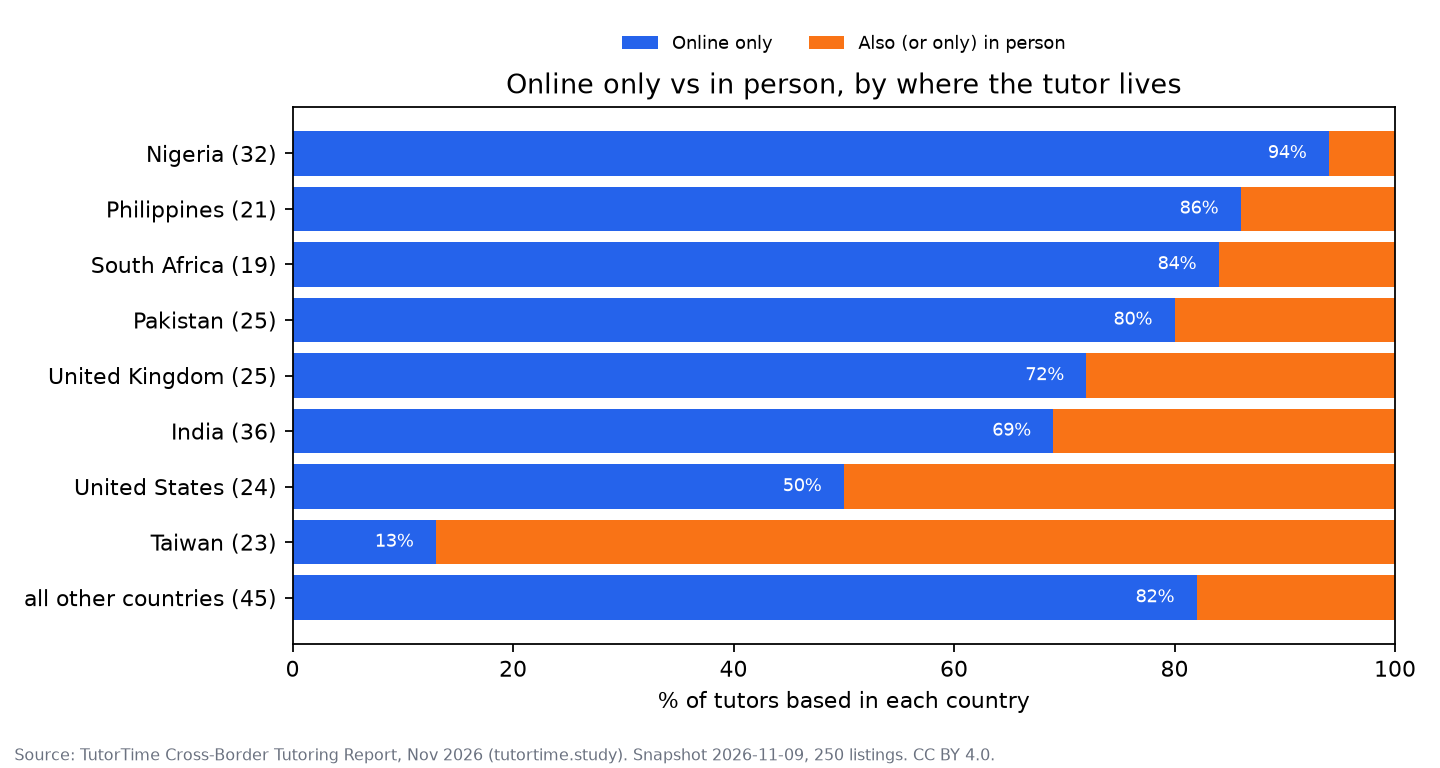
| Tutor's home country | Tutors | Online only | Also (or only) in person |
|---|---|---|---|
| Nigeria | 32 | 94% | 6% |
| Philippines | 21 | 86% | 14% |
| South Africa | 19 | 84% | 16% |
| Pakistan | 25 | 80% | 20% |
| United Kingdom | 25 | 72% | 28% |
| India | 36 | 69% | 31% |
| United States | 24 | 50% | 50% |
| Taiwan | 23 | 13% | 87% |
| 27 other countries | 45 | 82% | 18% |
| All tutors | 250 | 72% | 28% |
Countries are listed individually when at least 14 TutorTime tutors live there; smaller countries are grouped.
Two kinds of tutoring market show up. In Taiwan and, to a lesser degree, the United States, tutors still meet many students face to face, usually in their own city. In Nigeria, the Philippines, South Africa and Pakistan, almost everyone teaches online, and many of their students are likely to be abroad. Families who are open to online lessons can choose from about three and a half times as many tutors as families who need someone in person.
Who prices in pounds, and why it matters
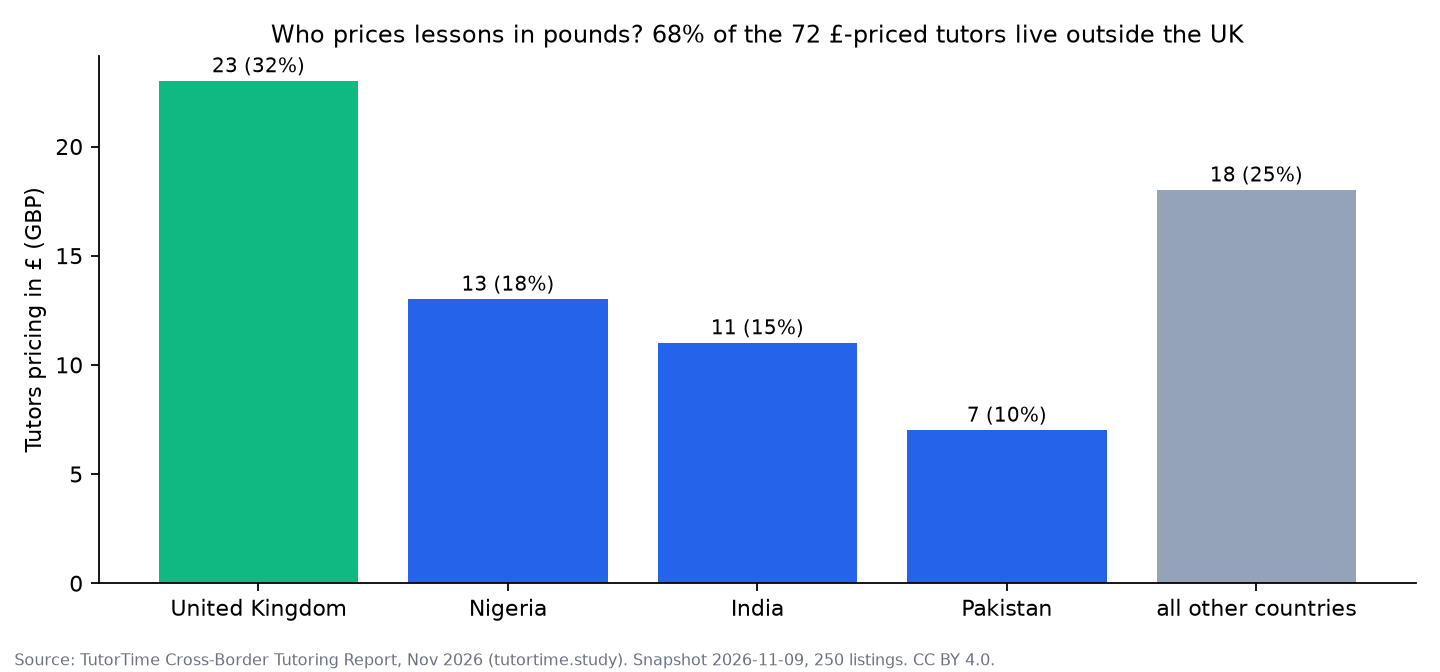
TutorTime tutors pick the currency of their hourly rate. 60% price in US dollars, 29% in pounds and 11% in New Taiwan dollars. The US dollar works as a global default: 84% of dollar-priced tutors live outside the United States. The pound is more telling, because a tutor in Lagos or Lahore who chooses it is usually pitching to UK families.
| £-priced tutors by home country | Tutors | Share of £-priced tutors |
|---|---|---|
| United Kingdom | 23 | 32% |
| Nigeria | 13 | 18% |
| India | 11 | 15% |
| Pakistan | 7 | 10% |
| 15 other countries | 18 | 25% |
| All £-priced tutors (19 countries) | 72 | 100% |
Seen from the other side, 41% of TutorTime tutors in Nigeria price in pounds, as do 31% in India and 28% in Pakistan. Hardly any tutors price in NT$ from outside Taiwan (fewer than 5).
Same country, different market: pound pricing earns more
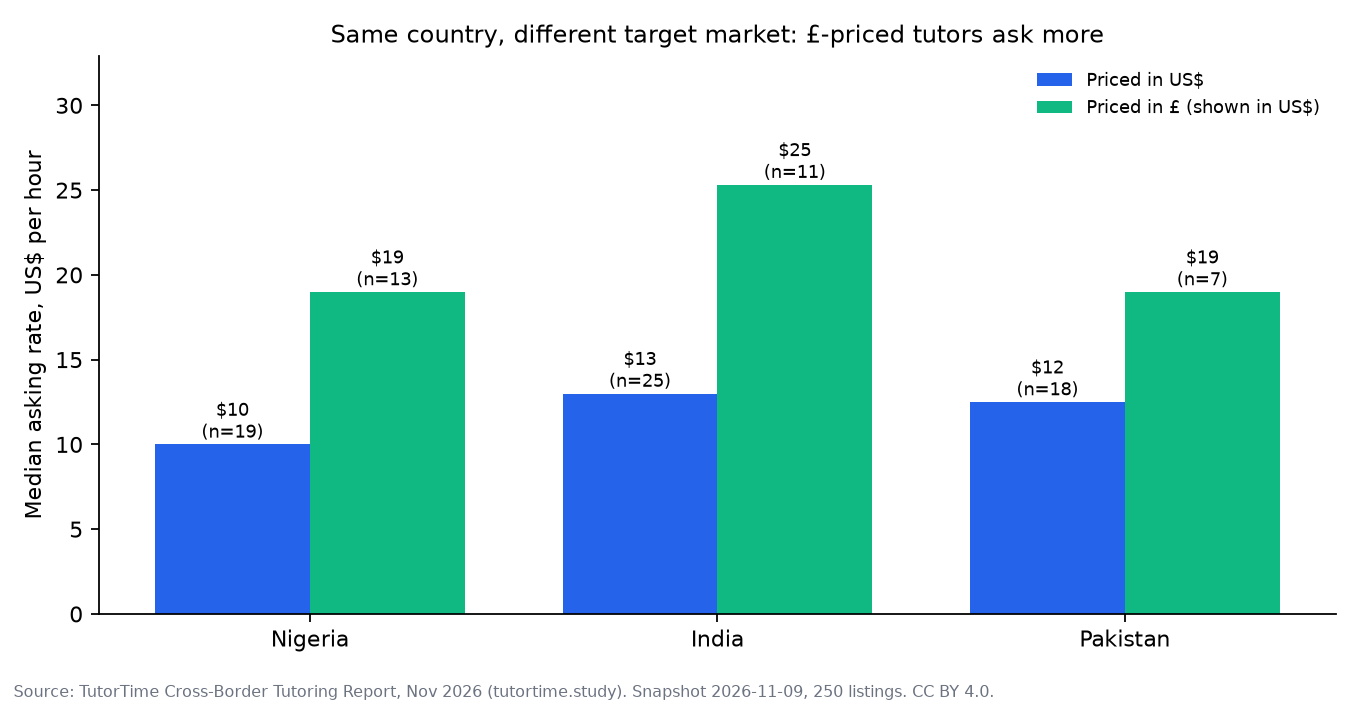
| Tutor's home country | Priced in US$: tutors | Median, US$/hr | Priced in £: tutors | Median, shown in US$/hr | Difference |
|---|---|---|---|---|---|
| Nigeria | 19 | $10.00 | 13 | $18.99 | +90% |
| India | 25 | $13.00 | 11 | $25.32 | +95% |
| Pakistan | 18 | $12.50 | 7 | $18.99 | +52% |
Pound prices are converted to US dollars at the rate TutorTime shows on each listing. Across all 31 £-priced tutors in these three countries, the typical tutor asks 65% more than the median dollar-priced tutor in their own country (geometric mean).
That doesn't mean switching currency doubles a tutor's income. Tutors who aim at the UK also differ in what they teach and how long they've taught (next section), and asking rates aren't the same as bookings. But it does show that tutors in these countries see UK families as a higher-paying market, and that UK families can still find experienced tutors abroad for well under the median of UK-based tutors on TutorTime (US$37.97 an hour).
What cross-border tutors teach
| Group | Tutors | Teach IGCSE or A Levels | Teach IB | Teach SAT, ACT or AP | Teach maths | Median years teaching | Median rate, US$/hr | Also in person |
|---|---|---|---|---|---|---|---|---|
| £-priced, living outside the UK | 49 | 45% | 31% | 33% | 43% | 8 | $25.32 | 18% |
| $-priced, living outside the US | 127 | 34% | 18% | 28% | 52% | 6 | $12.00 | 17% |
| UK-based (£) | 23 | 74% | 26% | 30% | 48% | 11 | $37.97 | 30% |
| US-based ($) | 24 | 4% | 8% | 29% | 50% | 9 | $45.00 | 50% |
Tutors abroad who price in pounds look like the UK market they serve. They are more likely than other tutors abroad to teach British-curriculum qualifications (IGCSE and A Levels) and the IB, and they have about two more years of experience. Cambridge IGCSE alone is taught in more than 7,000 schools in 147 countries (Cambridge International), so many of these tutors will have studied or taught it at home.
Do their hours fit students abroad?
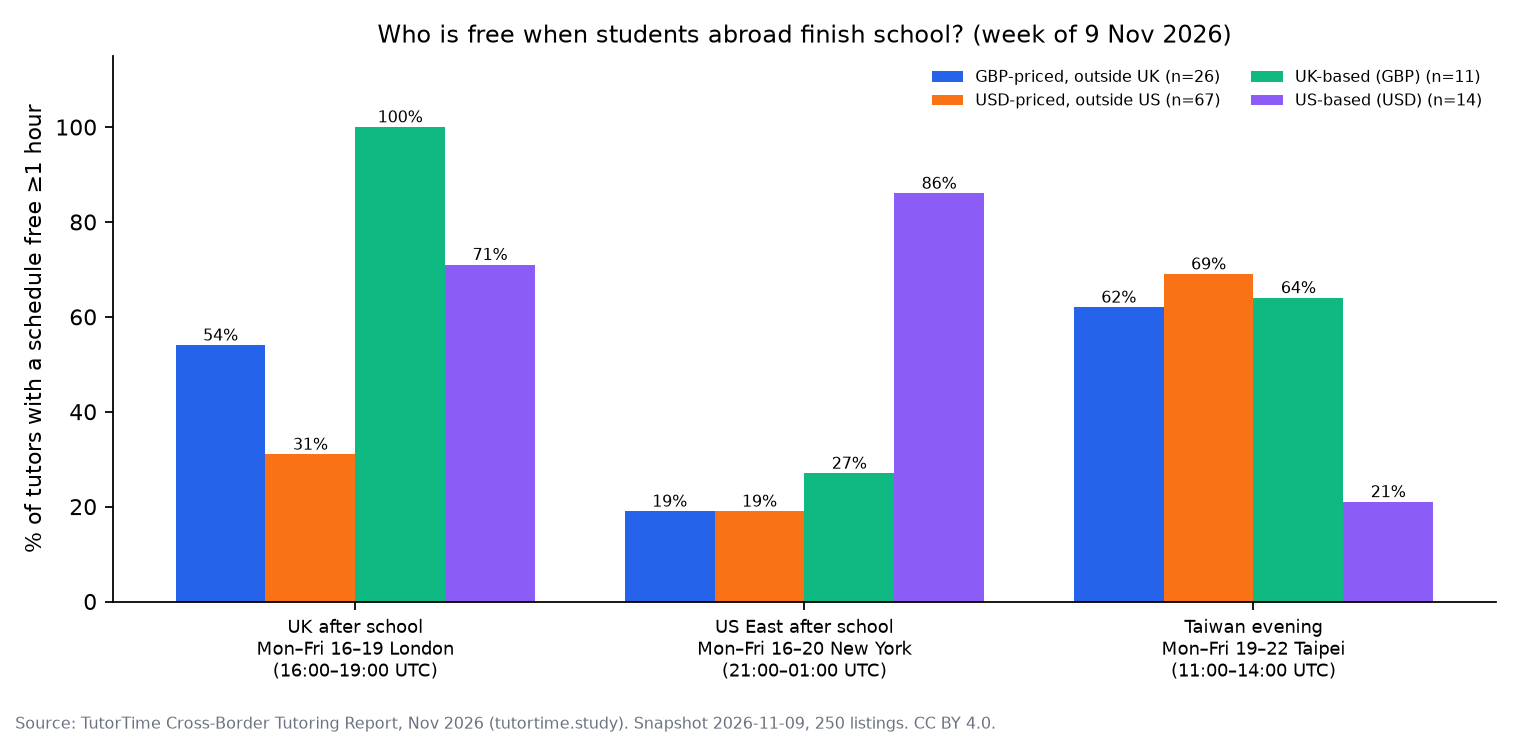
All times are for the week of 9 November 2026, when UK time equals UTC and US Eastern time is UTC−5. Tutors count as free if their published weekly schedule has at least one hour inside the window on at least one weekday.
| Group (tutors with a published schedule) | UK after school, Mon–Fri 16:00–19:00 UTC | US East after school, Mon–Fri 21:00–01:00 UTC | Taiwan evening, Mon–Fri 11:00–14:00 UTC |
|---|---|---|---|
| £-priced, outside the UK (26) | 54% | 19% | 62% |
| $-priced, outside the US (67) | 31% | 19% | 69% |
| UK-based (11) | 100% | 27% | 64% |
| US-based (14) | 71% | 86% | 21% |
| All tutors with a schedule (127) | 44% | 27% | 60% |
Most TutorTime tutors outside the US live in Africa and Asia (Nigeria, India, Pakistan, the Philippines, South Africa), where UK afternoons and East Asian evenings fall in their own afternoon or evening. US East Coast evenings land in the middle of their night, so only about one in five tutors abroad offers them. For US families, that makes local tutors, or tutors in the Americas, the easiest fit after school, while weekend slots (see our tutor availability report) widen the choice.
When clocks change in March, UK after-school hours move to 15:00–18:00 UTC and US Eastern to 20:00–00:00 UTC.
What this means for families, students and tutors
- Look beyond your own country if you can learn online. Most TutorTime tutors teach only online, and many already work to UK, US or Asian school timetables. Start with online tutors and filter by subject.
- Check the price currency and the time zone, not just the rate. A tutor priced in pounds abroad is usually aiming at UK families; check their weekly schedule against your after-school hours in UTC.
- Ask about the exam board. If your child sits IGCSE or A Levels, ask whether the tutor knows your board (Cambridge, Pearson Edexcel, AQA or OCR). See A Level tutors and maths tutors.
- Need someone in person? Choose fewer tutors near you: browse private tutors or search by location.
- Tutors: say who you teach. Pick the currency your students pay in, publish your weekly hours, and list the curricula and exam boards you know. You can list for free and keep all of your fee.
FAQ
How many online tutors teach students in other countries? We can't see where students live, but 98% of TutorTime's 250 tutors teach online and 72% teach only online, so most can take students anywhere. Among tutors who price in British pounds, 68% live outside the UK.
Where do online tutors for UK students come from? On TutorTime, two in three tutors who price in pounds live outside the UK, most often in Nigeria (18% of £-priced tutors), India (15%) and Pakistan (10%), with the rest spread across 15 other countries.
Are tutors abroad cheaper than UK tutors? Usually. The median £-priced tutor living outside the UK asks US$25.32 an hour, against US$37.97 for UK-based tutors. They also have a median of 8 years' experience, against 11 for UK-based tutors.
Do tutors charge more when they price in pounds? In Nigeria, India and Pakistan, tutors who price in pounds ask 52% to 95% more than tutors in the same country who price in dollars, about 65% more overall. Part of the gap reflects differences in subjects and experience.
Can I find a tutor abroad for US after-school hours? It's harder. Only 19% of TutorTime tutors outside the US who publish a schedule are free during US East Coast after-school hours (21:00–01:00 UTC in November), compared with 86% of US-based tutors.
Is online tutoring as effective as in-person tutoring? Good online tutoring can work well. In a randomised trial in Italy, three hours a week of online tutoring raised maths scores by about 0.2 standard deviations, comparable to many in-person programmes (AER).
Can I use this data? Yes, under CC BY 4.0. Please credit "TutorTime Cross-Border Tutoring Report, Nov 2026" with a link to this page.
Methodology and limitations
- Data: every public listing in the TutorTime directory (tutortime.study/find) on 9 November 2026 at 00:01 UTC: 250 tutors in 35 countries. Trend figures use our earlier snapshots of all public listings on 8 October (162) and 26 October 2026 (236).
- Market signal: TutorTime tutors can price in a small set of currencies (mainly US$, £ and NT$), so a tutor's currency is a choice, not a fact about their students. We read a non-UK tutor's choice of pounds as aiming at UK families. The US dollar is a common default, so we don't read dollar pricing as aiming at the US.
- Prices: advertised hourly asking rates, converted to US$ at the rate shown on each listing. Medians only; no minimum or maximum is published. The +65% figure is a geometric mean of each £-priced tutor's rate divided by the median $-priced rate in their own country.
- Schedules: 127 tutors (51%) publish a weekly schedule. Windows are tested in the reference week 9–15 November 2026 using each tutor's own time zone; a tutor counts if they have at least one free hour in the window on at least one weekday. UK-based (11) and US-based (14) schedule groups are small, so treat those figures as indicative.
- Self-reported: countries, subjects, curricula, experience and lesson types come from tutors' own listings and aren't independently verified.
- Small groups: every published figure rests on at least 5 tutors. Countries are named only when at least 5 tutors are in the group being described. No tutor can be identified.
- Not a market survey: TutorTime is a growing listing board, so these numbers describe its tutors, not every online tutor. They shouldn't be read as national averages.
Sources
- TutorTime public tutor listings, snapshot 9 November 2026 (data appendix: `data-appendix.csv`, CC BY 4.0)
- WTO (2025), Digital trade in Latin America and the Caribbean, overview: global digitally delivered services exports. wto.org
- Sutton Trust (2026), Private Tutoring 2026 (Ipsos Young People Omnibus 2025). suttontrust.com
- Carlana, M. & La Ferrara, E., "Apart but Connected: Online Tutoring, Cognitive Outcomes, and Soft Skills", American Economic Review. aeaweb.org
- Nickow, A., Oreopoulos, P. & Quan, V. (2020), "The Impressive Effects of Tutoring on PreK-12 Learning", NBER Working Paper 27476. nber.org
- Cambridge International, Facts and figures. cambridgeinternational.org
Related TutorTime research
- What tutors charge in 2026
- When are tutors free worldwide?
- Tutoring in your language
- Exam tutors worldwide
Cite this report
> Source: TutorTime Cross-Border Tutoring Report, Nov 2026, tutortime.study/research/cross-border-online-tutoring-2026 (CC BY 4.0)